Based on insights from 166 asset, reliability and maintenance practitioners across Australia and New Zealand, this report reveals how organisations are approaching APM, where strategies are falling short, and what can help close the gap between strategy and work execution.
Fill in your details to download the 2026 APM Report and benchmark your organisation against insights from 166 asset, reliability and maintenance practitioners across Australia and New Zealand.
Asset Performance Management (APM) can help asset-intensive organisations improve asset reliability, maintenance decisions and operational performance. But the research reveals a significant gap between the potential of APM and how it is being implemented in practice.
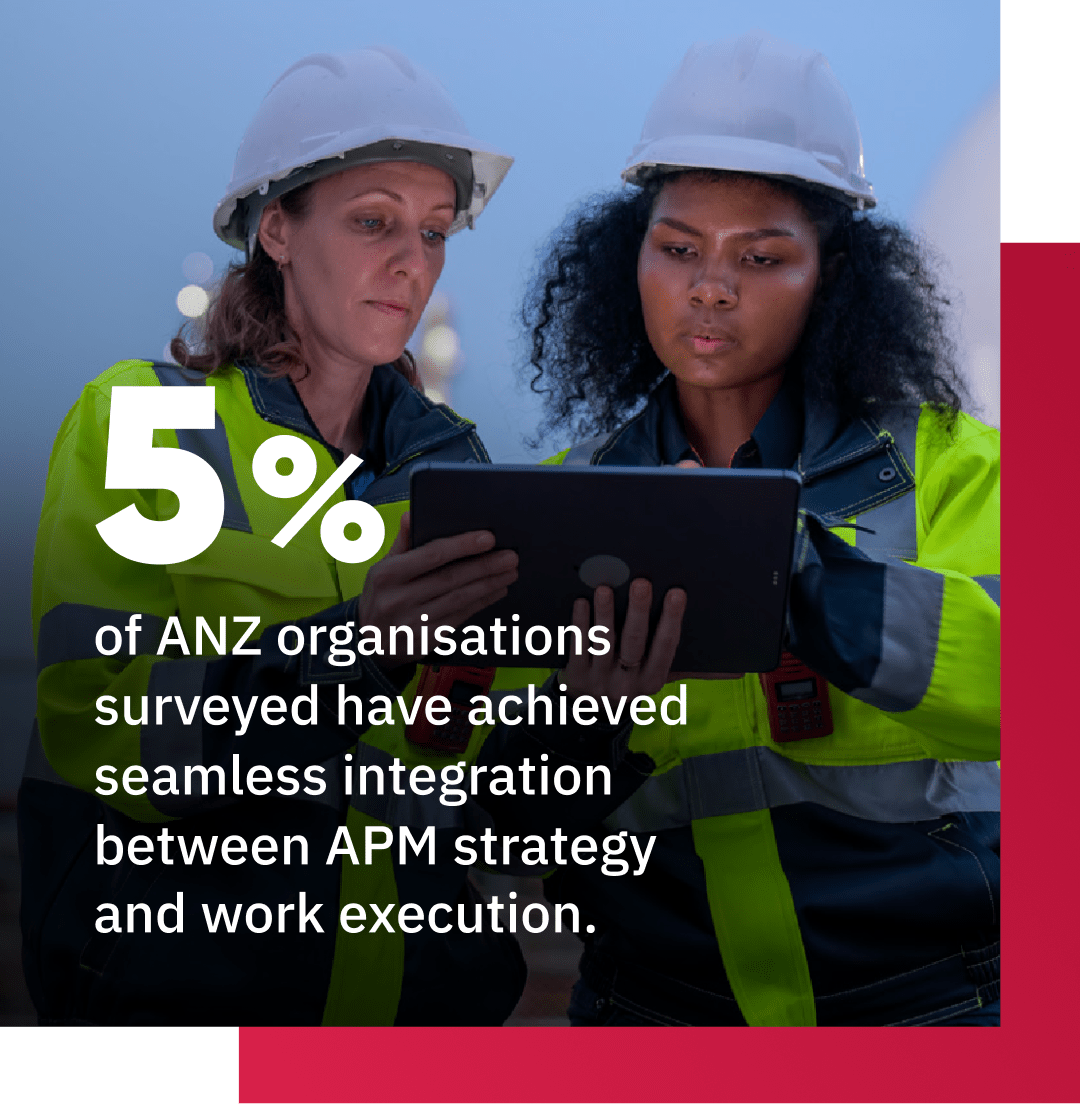
Only 5% of surveyed organisations report seamless integration between APM strategy and work execution, while organisational silos, data quality issues and unclear technology strategies continue to limit progress.
The report provides a practical, practitioner-led view of what is working, what isn't, and where organisations can focus to better connect APM strategy with operational outcomes.
Asset Performance Management (APM) is a strategic approach to improving the performance, reliability and lifecycle value of physical assets. It brings together asset strategy, maintenance and reliability practices, operational data and technology to help organisations make better decisions about their assets.
Enterprise Asset Management (EAM) focuses on managing physical assets, maintenance activities and work throughout the asset lifecycle. Asset Performance Management (APM) focuses on improving asset performance, reliability and decision-making. The two are complementary, with APM helping organisations use asset data and insights to inform maintenance and asset management decisions.
Effective APM can help organisations improve asset reliability and availability, reduce unplanned downtime, make better maintenance decisions, manage asset risk and improve how asset investment is prioritised. The greatest value comes from connecting asset strategy, data, technology and work execution rather than treating APM as a standalone technology solution.
The 2026 research found that many of the biggest barriers to successful APM are organisational rather than purely technological. These include stakeholder buy-in, cultural resistance, budget and resource constraints, disconnected processes, organisational silos and data quality.
APM is broader than a technology platform. While technology, analytics and asset data can enable APM, successful Asset Performance Management requires a clear strategy supported by people, processes, data and technology. In the 2026 research, 57% of respondents viewed APM as a strategic approach, while 28% primarily viewed it as technology.
APM strategies can fail to translate into day-to-day action when asset strategy, reliability, maintenance planning and work execution operate in silos. The 2026 research found that only 5% of respondents had achieved seamless integration between APM strategy and work execution, highlighting the importance of connecting strategic asset decisions with operational delivery.
Benchmark your organisation against 166 practitioners across Australia and New Zealand and uncover the gaps that could be limiting the value of your APM investment. Get practical insights into connecting strategy with execution, strengthening collaboration, improving your data foundations and making better decisions about APM technology.